
How to crate train a German Shepherd puppy
is one of the most important skills every new GSD owner must learn. One of the most important things you can do to develop a well-behaved, confident, and happy dog is to crate train a German Shepherd puppy from an early age. German Shepherds are bright, loyal and energetic dogs, which makes them both a delight to teach and a struggle if not directed properly. A crate provides a secure environment for your puppy and helps prevent destructive behaviours when you cannot supervise them.
In this thorough tutorial you’ll discover how to crate train your German Shepherd puppy step-by-step, including the correct crate size, a daily plan, how to handle nighttime crying, and the most common mistakes. These proven approaches will help you build a solid foundation, whether you have an 8 week old or 6 month old puppy.
Why Do You Need to Crate Train a German Shepherd Puppy?
Many novice dog owners feel terrible about using a crate, thinking that it is harsh or restricting. In fact, dogs are natural den creatures. If correctly introduced, a crate is a safe den for your German Shepherd puppy, not a punishment.
Benefits of Crate Training Your GSD Puppy Here are the main benefits:
- Greatly speeds up potty training.
- Prevents chewing, destruction and home accidents when left alone
- Provides a safe haven for your pet help reduce separation anxiety
- Makes travel, vet visits and boarding much easier
- Helps to create a daily schedule which German Shepherd’s thrive on
How to Pick the Right Crate for Your German Shepherd Puppy?
You need to choose the correct crate kind and size before you start training. Most owners don’t think that’s an important decision.
Best Crates for German Shepherds
Wire Crates: These are the most popular choice. They offer excellent ventilation and visibility and usually come with a divider panel so you can adjust the size as your puppy grows. Ideal for home use.
Plastic (Airline) Crates: More enclosed and den-like. Great for travel and puppies who feel more secure in a darker space.
Heavy-Duty Metal Crates: Recommended for older or more active German Shepherds who may try to escape. Not usually necessary for puppies.
Proper Crate Size for a German Shepherd
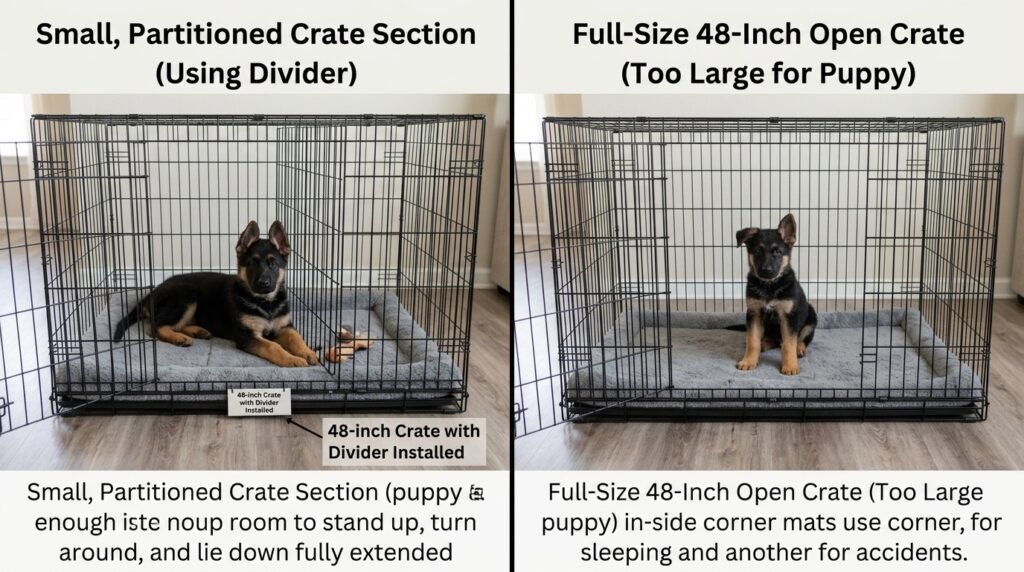
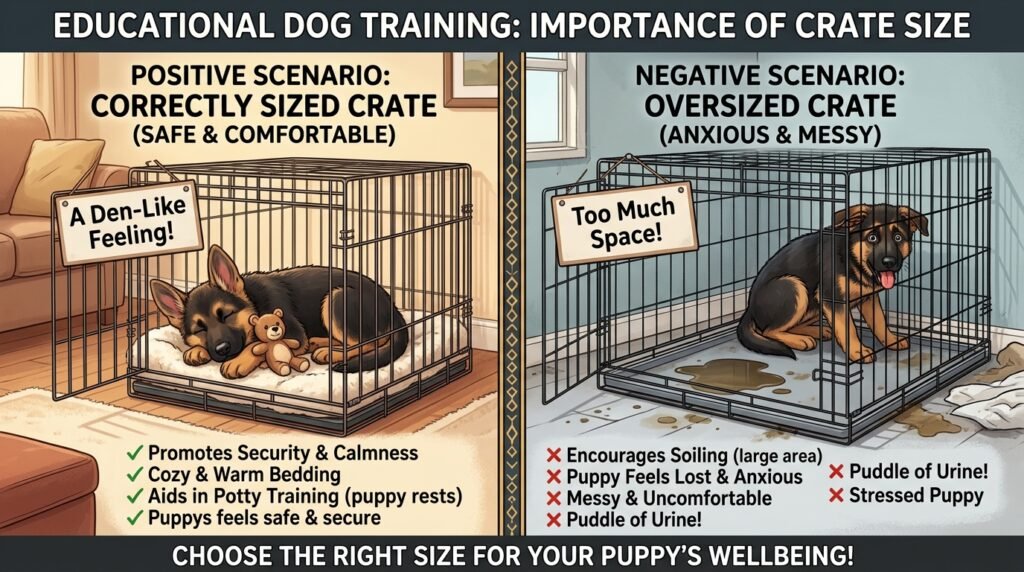
A full-grown German Shepherd needs a container that is at least 42 to 48 inches long. However, if you have a puppy, a too-large crate contradicts the objective of potty training because they will use one corner for a bathroom and sleep in the other.
Use a wire cage with a divider. Begin with a smaller confined space and make it bigger as your puppy gets older. The crate should be big enough for your puppy to stand up, turn around, and lie down comfortably.
How to Crate Train the German Shepherd Puppy: Step by Step Instructions
Introduce the Crate in a Positive Way
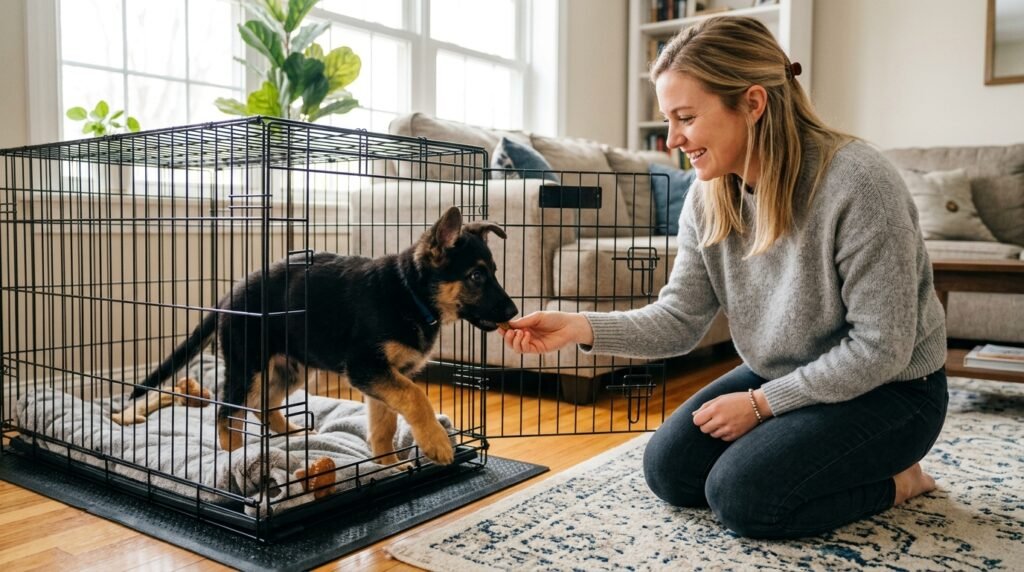
Never coerce your dog into the crate. Put the crate in a high-traffic part of your house, such as the living room, so your puppy doesn’t feel secluded. Leave the kennel door open and allow your puppy to roam freely.
Fill with tiny snacks or kibble. Let your puppy come in, take the treat and walk out on their own. Do this several times a day for one to two days. Now your puppy should start connecting the crate with something good.
You may also add a used t-shirt or blanket with your fragrance in the crate to make it more comfortable and familiar.
Feed Meals Inside Crate
As soon as your puppy is entering the box willingly, begin giving his meals in the crate. For the first couple of meals, put the food bowl just inside the entryway and gradually move it more toward the back.
Serve a few meals like this, then close the door while your puppy eats and open it as soon as they’re done. gently increase the amount of time the door is closed after the meal (start with 1 to 2 minutes and increase gently).
Short Crate Sessions
Now it is time to practise closing the crate door when your puppy is not eating. To get your pup into the crate try a treat or Kong toy filled with peanut butter. Give a simple command such as “Crate” or “Go to bed.”
Close the door, sit quietly nearby, and open it after 5 to 10 min. Work up slowly to 30 minutes, then an hour, always rewarding calm behaviour. Do not open the crate door when your puppy is whining – wait for a quiet moment.
Gradually Increase the Crating Time
When your puppy can be left in the crate for 30 minutes without fussing, you can start leaving them for longer amounts of time when you have to leave the house or do chores. Always ensure they’ve had exercise and a toilet break before heading in.
A rule of thumb for how long a puppy can hold it: their age in months plus one. So a 3 month old dog should not be crated for more than 4 hours throughout the day.
Crate Training During Night
German Shepherd pups whine at night in their box. This is a typical phase and it will pass. This is the best way to tackle it:
Position the kennel beside your bed in your bedroom so your puppy may be close to you
Puppies under 12 weeks may need to toilet once every 3-4 hours during the night
To replicate the heartbeat of littermates, put a ticking clock in a towel near the crate
If your dog whines, wait to be sure it is not a potty need, then ignore crying until there is a pause – praise the quiet
Allow your dog to relax in over days and slowly move the crate to the permanent place.
Sample Daily Crate Training Schedule for a German Shepherd Dog
| Time | Activity |
| 7:00 AM | Wake up — immediate potty break outside |
| 7:15 AM | Breakfast in crate — keep door closed 5 min after eating |
| 7:30 AM | Playtime and exploration (supervised) |
| 9:00 AM | Potty break, then crate for nap (1–2 hrs) |
| 11:00 AM | Potty break, play, training session (10 min) |
| 12:30 PM | Lunch in crate |
| 1:00 PM | Crate nap (1–2 hrs) |
| 3:00 PM | Potty break, outdoor exercise |
| 5:30 PM | Dinner in crate |
| 6:00 PM | Evening playtime, socialization |
| 8:00 PM | Potty break, wind-down time |
| 10:00 PM | Final potty break, bedtime in crate |
Common Mistakes in Crate Training
Using the box as punishment: The crate should always be a good place. Do not send your puppy to the crate in anger or as a punishment for bad behaviour.
Crating too long: Puppies need lots of breaks. Being over-crated leads to anxiety, accidents, and bad crate associations.
Responding to whining – If your dog is crying and you open the crate, you educate them that whining gets results. Open the door at a time when things are calm.
Skip the Introduction Phase: Forcing your puppy into a crate without first introducing him to it will cause dread and resistance. First spend some time building pleasant associations.
Wrong crate size: Too big means accidents in the potty. Small is uncomfortable. Small is stressful. Use a dividing panel to get the size just perfect.
How to Pick the Right Crate for Your German Shepherd Puppy?
Most German Shepherd puppies are crate trained between 1 to 3 weeks with continuous daily practice. Puppies introduced to the crate at 8 weeks old usually adapt the quickest. It may take older puppies or dogs who have had bad experiences 4 to 6 weeks.
The main thing is consistency. If you skip days, or send mixed messages, training will take a lot longer. Be consistent with the approach every single day and your German Shepherd will reward you with good behaviour.
Crate Training Tips for Success
- Always exercise your puppy before crating – a tired puppy calms easier
- Stuff a Kong toy with frozen peanut butter or wet food to keep dogs busy in the crate
- Drape a blanket over 3 sides of the crate to give it a “den” feel
- Never push the process because every puppy learns at a different rate
- Put the crate in a sociable area at first so your puppy doesn’t feel lonely.
- If your puppy is very anxious, use a relaxing pheromone spray such as Adaptil over the bedding in the box.
Frequently Asked Questions
When should I start crate training my German Shepherd puppy?
You can begin as early as 8 weeks. Early is always best, but with patience and consistency, any age will work.
Is it okay to confine a German Shepherd puppy all night?
Yes, crating overnight is fine once your puppy is mature enough to retain his/her bladder for 6-8 hours. Puppies less than 3 months old will need to go out and eliminate at least once overnight.
My German Shepherd puppy howls in the box for hours, what should I do?
First rule out a potty requirement. If the puppy does not need to go out, wait quietly and unlock the crate only when there is a moment of quietness. Get more exercise before crating and make sure the crate intro was slow enough.
Do I put water in the crate?
Water is NOT required for brief crating sessions of less than 2 hours. For longer periods of time, you can attach a no-spill bowl to the crate door. Avoid water bowls that tip over, soaking the bedding.
Conclusion
Crate training a German Shepherd puppy requires time, patience, consistency, and a positive approach. Crate training, when done right, is not harsh – it gives your puppy a safe, comfortable, secure area that they will happily use for years to come.
Choose the proper-sized container, create positive associations slowly, keep a routine, and avoid frequent blunders. One of the smartest dog breeds in the world is the German Shepherd. With your supervision, they will love their box and become the well-rounded companion you have always dreamed of.
For more expert dog care advice, training guides and product reviews visit pawlifeguide.com and check out our comprehensive collection of information developed for enthusiastic dog owners just like you.